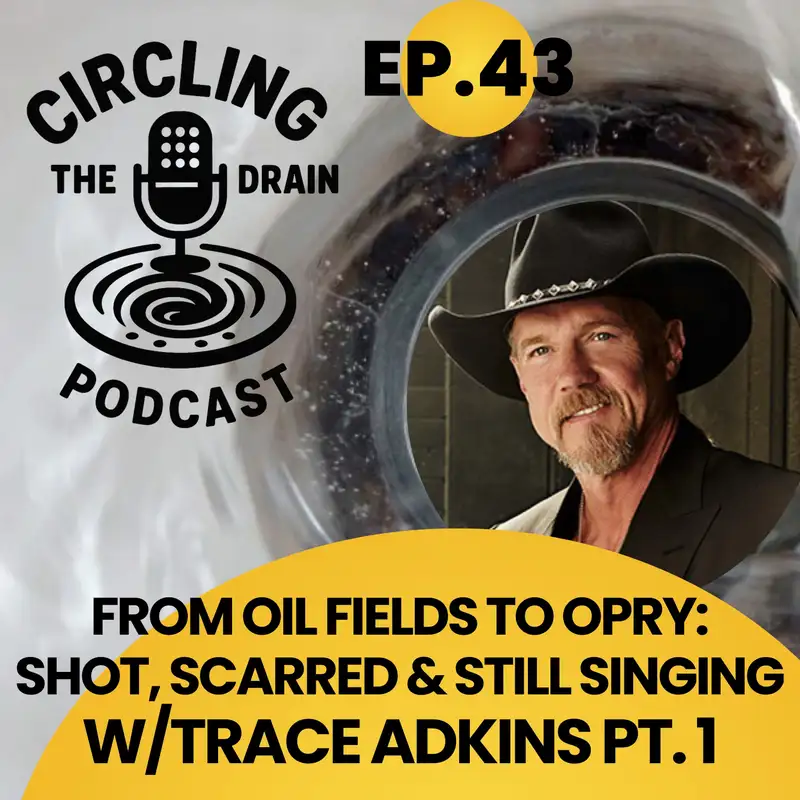
Trace Adkins: Near-Death Stories, Oil Rigs, And 30 Years In Country Music :: Ep 43 Circling the Drain Podcast
Unknown: Hey guys, we've got a
very special episode of Circling
the Drain. In fact, it's going
to be a couple of episodes for
you with a very special guy. I'm
talking about a country music
legend, Trace Atkins.
Man, what? What a treat that
everybody is going to be in for.
We talked to this man for three
episodes worth
at least, at least,
so gracious in giving us all of
that time, and man, the stories,
and the well, you're just gonna
have to stick around and check
it out,
yeah, because he's the, he's
probably the nicest hostage
you've ever seen, so I hope you
enjoy it.
Welcome to a podcast about music
and entertainment. Before it all
goes down the disposal, this is
Circling the Drain.
Welcome back to Circling the
Drain. It's Johnny Bozeman, but
you know me as Johnny B. J.
Harper, right there.
Hello, mr. Bozeman. John Earnest
Bozeman, little hidden, a little
secret there. And, of course, we
have the.. I'm not even gonna
say, I'm not gonna say James
Patrick, even though I just did,
but Jim McCarthy.
Thank you.
Running the running the show
here,
yeah, he does. He pilots it to
keep it from smacking into the
into the sand to
do something. Yeah, whatever.
I'm smacking
into something. Please forgive
me, man. I've just got out of
the hospital, so you know,
so many good things going on,
yeah, there are, there's so many
things going on, but we this
time, and we've had guests on
the show, you know, a lot of
musical guests, a lot of people
in the music industry, but this
time we've got a legitimate
country legend, ladies and
gentlemen, and
he walked right in like it was
superstar, like it was just like
we're old butts. Well, he is no
presumptions. He is that way,
and that's
why I have a lot of respect for
this man. Not only do I dig his
music, but I dig him as an
individual. And it's an honor to
have Trace Atkins with us. Yeah,
you doing, brother? Good to be
here, man.
Hitting the big time, Johnny B,
always. Yeah, you don't
see the audience, they're over
there.
Come on, treat, you never, you
never get tired of hearing that
applause, though, right? I mean,
the audience, I mean, that's
kind of the one of the one of
the reasons you do what you do,
right, is you enjoy making
people happy.
Well, you know, hopefully, yeah,
you know, but that applause,
yeah, that's that's that's the
only tangible result you get
from what you do in this
business, and, and the weird
thing is, I mean, you know, it's
great, but it lasts about as
long as that did, and then you
go back to the bus and go, well,
what was that all about,
no.
I miss you. That's the reason I
work like I do. You know, when
I'm not on the road, I'm on the
farm. I just.. I came over here
from.. I've been working. I'm
sorry, but no, I live right down
the road from here. So, anyway,
so I worked right up until the
time I had to get here, and then
I came on over, but I like to do
physical stuff, and then at the
end of the day I can look back
and say I can tell what I did
today. I have tangible results
from what I did, and I need
that, you know. So that's what
you know having to farm gives
me, and that's the way I grew up
with blue collar jobs. I still
need that in my life, but this
other gig is just, yeah, you
know, tangible results are not
there. You just get off the
stage and go to the bus.
Well, the thing is, I one time I
looked at Twitter, or I guess,
which is X now, and Victoria had
put up your wife and put up this
video. Now, see, this is the
thing with Trace. I always.. I
feel like a man, you know, at
this point in my life, but every
time I get around this guy, I
feel like a little boy. Listen,
I feel like a.. but I'm looking
at this video, man. This dude's
taking down this huge, huge ass
tree. Yeah, and I'm thinking, I
don't do that, you know, I feel
like country boy, but yet this
guy's doing the hard work.
Well, there was a reason I was
doing that, though. I don't post
stuff of me working in there.
No, you do
not. But
this guy, this regional rep for
Steel, had given me this big, I
mean, a big chainsaw. Oh, it was
cool with like 42 inch bar on
it, or something big, huge
change, though. Because after
the Beatles came through a few
years ago, killed all the ash
trees. Oh yeah,
you know, and man, I got some
ash trees on my place, they're
massive, and I had a 24 inch
bar, but it wasn't quite big
enough to handle, so you know.
Reached out to the steel guy,
and he said, "Yeah, I'll hook
you up. So he hooked me up with
this saw, and then I was like,
"You know, I should do voiceover
stuff for steel. And so my wife
was like, "Well, let's just do a
little video of you cutting down
one of those big hash trees with
that new steel saw, and then
we'll give it to them, and
they'll probably give you a gig,
is you know, voiceover stuff,
and I was like, yeah, let's go.
So we did it, and I thought the
steel people would be able to
use it, but they couldn't, you
know why? And I thought I had
everything right, man. I had, I
had the helmet on, and the face
guards, I had all the stuff, but
I didn't have on glove, and so
they wouldn't, they couldn't use
it. That's what the dude said.
He said, "We can't use it. You
didn't have gloves on. Sorry
about that. I didn't get the gig
anyway. And then I heard it the
other day, they got this new
commercial with this gravelly
voice. Dude sounds kind of like
you made me mad. I told
Victoria, I said I'm gonna go
take that saw and throw it in
the pond, because I didn't get
the voiceover still, man.
But, man, you've had a good run
with Firestone, though, right?
Had a
great run, I think I was almost
1214, years. Yeah, yeah, they
let me go, and every year when
they kept re-upping the
contract. I thought surely these
guys are going to this campaign,
they're going to go in a
different direction at some
point. So I had, I had probably
seven or eight years more than I
thought I was going to get, and
the contract just ran out this
past year, and they didn't
re-up, and I was like, it's
about time, man.
But you did some stuff for KFC
too, didn't you?
Long time ago. Yeah, I did a
little KFC stuff. Yeah, that
didn't last too long, but you
know, I've done things over the
years. There was a fast food
chain in Southern California,
Farmer Boys. I did that for a
while, and so I've been
fortunate to do a lot of that
stuff, and I still do a lot of
voiceover stuff for Wounded
Warrior Project. Right, right,
yeah. I've seen you on. I
appreciate you doing that kind
of work.
Amen. I love those guys. That's
a great ordinance. Yeah,
anything for the vets, brother?
I kind of see Lululemon in your
future, you know? Maybe, oh my
gosh, you know what they owe me.
I've got five
daughters, and they love, and I
mean, they'll go in there, and I
can't believe it, they'll buy a
pair of tights, right? Yeah, I
mean, just regular, like $80 a
pair, right. Oh my god, like,
are you kidding me? It's
unbelievable how much this stuff
costs in there.
But the funny thing is, is that,
of course, I'm joking, but I
mean, as I'm thinking about it,
that's actually not a bad idea.
If Lululemon, or a brand like
that, is listening to have a
voice like yours, like the
juxtaposition, I mean, yeah, you
know, right? Exactly. Plus,
you've got five daughters, man,
right? Always makes me think,
too. Every time I hear about
your daughters, have you had fun
with the boyfriends? I mean, can
you share some of those stories
with us? Yeah, please. I know I
don't want to embarrass your
daughters, or
no, my oldest when she was in
college, she had a boyfriend one
time that he wanted to hunt out
on my place, and I was like, oh
yeah, okay, so I didn't normally
let people do that, but I went
out in the woods with him, and I
took him back in the back where
there was this huge white oak
tree, and I was like, you know,
this would be a good spot for
you to put a stand, and we were
just out in the middle of the
woods, and I turned to him, and
I said, you know, I could kill
you right now, nobody would
ever, ever even know what
happened to you, I just run your
truck off in the pond, and then
I'd just go, I ain't seen him,
I'll take my backhoe, dig a big
old hole, bury you in, and I
was, he was nervous looking, you
know, but I was like, I'm just
kidding, you know, yeah. And
then later that night I was
sitting at the dinner table in
the house, and my daughter came
home from college, she was going
to MTSU at the time, and she
came into the house just since
she came in the door. You're a
psychopath. Yeah, he didn't stay
around, and there was another
one one time that you know, I
can't remember his name. I don't
even remember what he looked
like, but he.. I just.. he'd
been around a few times, and I
could just tell it was like, you
know, he's not gonna make it,
she's not, he's not gonna make
it,
right?
You know, and so I just told
him, you know, like, dude, I'm
trying to help him right now,
you should just go ahead and.
Just get out, you're not gonna
make it, you know. Yeah,
you're just not gonna make it.
So, you need to cut your losses
and get out, yeah. Brother out,
and he did,
yeah. Well, he's smart, he
listened to you,
yeah. Well, you know, he, you
know, he should, he should be
grateful. I knew he wasn't gonna
make it. He wasn't gonna make
the cut.
So, do you understand women more
having five? No, I tell
people all the time, you know,
having five daughters and three
ex-wives. You know, I'm more
confused. I'm five times more
confused about women than you
are, because I have five
daughters, and it's just.. I
don't understand them. I still
don't
see.. I still don't either. I've
been married a couple of times,
and
yeah, and
at one time was even a
stepfather to some girls, and
girls were sweet as can be. They
were ornery, but I'm like you,
man, I still don't understand.
Yeah, well,
I love them, but I don't
understand. I don't
understand them either, man. I
don't.
So, when you got started, you
grew up in Serepta. Am I
Louisiana? What got you into
music? What, what drew you
well? well, my first memory of
music appreciation was standing
beside my granddaddy in church,
and he, he had a beautiful, rich
bass voice, and he would always
sing the bass parts on all the..
that was back in the day when
the whole congregation knew
their parts,
yeah,
and when they would sing, it was
everybody was singing parts. My
mama sang alto, my granddaddy
was singing the bass part. You
had a few tenor singers around,
you know, and the sopranos, and
it was just beautiful. But I
remember standing by my
granddaddy and just listening to
him sing and thinking, man,
that's what I want to do, I want
to sing bass like my granddaddy.
And then that's what I started
doing in a gospel quartet early
on. I was 17, I started singing
bass in a gospel quartet. Did
that for a few years, and I
absolutely loved it, you know.
And that was when I kind of
started to realize, oh my gosh,
man, the chicks dig the bass. Oh
yeah, they do. Chicks dig,
they don't
care about the tenor singer,
they like the bass. Oh yeah, so
that, that, that started it,
man. It was over after that, you
know, I really, that's what I
wanted to do. So,
well, as far as country music,
what'd you get into at that?
I was doing little, like, you
know, Saturday nights around
where I grew up, there were all
those little hay rides and
jamborees, right, where they had
a house band, and you just go in
and, you know, get up and do
haggard tunes or buck Owens or
whatever, and you know that's
what I kind of, what I started
doing, but I didn't get a break
until I was working offshore on
a drilling rig, and I would take
my guitar out there, and you
know, when I worked my 12 hours,
I'd go up to the wheelhouse up
at the very top, where it was
quiet, and I'd try to write and
stuff, and then guys started
coming up there wanting me to do
certain songs, whatever. And
then I met this dude out there
that knew a guy that was in a
band in Lafayette, Louisiana,
and he said, "Me introduce you
to him when we have our two
weeks off, and he was on my
crew, and so you know I liked
him a lot, and so I said, "Okay,
man. So we went on our two weeks
off, and I went down to
Lafayette and sat in with these
guys in a club one night, and
then it just went from there,
man. They said, "We're doing
this competition, we've already
won the locals, we're going to
the regionals in Dallas. Want
you to go with us and sing some,
and so we went out there, and we
actually won. The thing
was that the country showdown,
it was the Wild Turkey battle.
Okay, Wild Turkey
had won, that's right, yeah,
a long time ago. So we came to
Nashville for the finals, and we
didn't win, but it was, it was a
good experience. But when we
played in Dallas, there were
some booking agents in the
audience. They booked us to
start playing clubs in Texas,
and so that's what I took a
leave of absence from Global
Marine, and when did that for
about four years, just played
the club circuit in Dallas, New
Mexico, he went as far as
Arizona, and then we played a
couple of places in Louisiana,
and one in Mississippi, and
Jackson, but we just ran that
circuit, you know, where you'd
start on a Tuesday night and
finish on a Saturday night, it's
five nights a week, four hour
dance.
Years, that's some dues paying,
right? Yeah, you know.
Well, I, you know, I was doing a
lot of drugs and staying drunk
all the time, and it was just,
man, it was a nightmare.
Finally, I just had to get away
with it. I knew I was getting
away from it. I was, I knew I
was going to kill myself. I
quit, but you know it was a
great experience, but I said
once I've moved up here and,
and, and got lucky and got a
record deal. I said, you know,
I've all the thing that I have
is I've, I've learned everything
that you're not supposed to do,
right?
You know, and I think those
lessons are just as if not more
important than what to do, I'd
already learned what not to do,
you know, and the way that you
shouldn't conduct yourself and
everything, so yeah, I got all
that out of my system back then.
Well, you know, you say you kind
of got the itch singing with
family in church, I mean, in
terms of instruments, I guess
was the guitar the first one you
picked up.
Yeah, my daddy bought me a
guitar when I was 10 years old,
and I don't even remember. I
never talked to him about it
either. I don't, I didn't get a
chance to ask him why he did
that, but one Christmas I had a
guitar, and then I was 10 years
old, and a couple of weeks later
I started taking guitar lessons
from this guy in Spring Hill,
Louisiana. Took guitar lessons
for a few years, and that's how
it started.
Were they like guitar gods that
kind of you drew influence from?
Any rockets listened to? No,
man. man, I'm a lazy guitar
player. I got to the point where
I could accompany myself,
right,
and I knew I knew the chords and
everything, and I could just,
you know, I could learn songs
and, and pretty much accompany
myself, and that was good enough
for me. Three
chords and the truth, yeah. I
didn't,
I didn't have a dream of
shredding, you know, I wasn't
going to be that
too late when, then when, when I
cut this finger off, you know,
there's cords I can't even make
anymore, I can't reach up the
neck, you know, and just there's
stuff I can't do right now, so,
and plus, I don't have any
feeling in this finger, you
know. So,
well, you brought up something
interesting, too, that man,
you've had a lot of, I mean, a
lot of accidents, a lot of
things happen to you. I mean,
you even got shot by a wife, I
mean, that's, and you survived,
yeah, obviously, you're a tough,
you're one tough sob, Johnny.
Yes, sir.
In this life, I have been a
participant, not a spectator.
That's why I'm scarred from one
end of my body to the other, you
know, because I have been in the
game, dude. Well,
you have. I mean, you like I
said, you got shot by an
ex-wife, which might.. and you
didn't press charges, which
was.. I thought big of you.
Well,
well, I mean, if it were me,
very honorable, because I mean,
if someone shot me, yeah, you're
going to jail.
Well, you know what, man.
Though, I mean, this is somebody
that supposedly loves you, and I
love you. And when that happens,
it's like, oh my, you know, of
course she didn't mean
to do it. No,
you know what I mean, right?
It's like she didn't mean to do
that. Yeah, I'd never seen her
shoot a gun ever. Yeah, I knew
she had one, but I'd never seen
her shoot one. And so,
boy, when you did, she.. yeah,
it was.. it was
glad you survived it.
Yeah, well, if it hadn't been
for Life Flight and Vanderbilt
Medical Center, I wouldn't have,
I swear, if I'd been anywhere
else, you know.
And by the way, Vanderbilt, if
you'd like some, you know,
people to do some commercials
for you. A couple of guys right
here, there's your guys. Yeah,
you can. Yeah,
I got on a Life Flight, they
picked me up in Mount Juliet and
took me to Vanderbilt, and so
I've stayed in ICU for a long
time, and they didn't really
expect me to make it. I don't
think.
Wow,
you know, I mean, the bullet
went in under this army, came
out under this arm, that's
crazy. Wow, went through my
straight through my heart, went
through both lungs, and so it
was, it was bad. So,
what was.. I mean, what's the
feeling like that? I mean, as
you know, you're being shot at
the time. Is it kind of.. do you
feel it?
Oh, I knew. I knew I had been
shot. I just remember getting up
off the kitchen floor. And I
walked down to, I don't even
know where I was going, I was
just in complete shock, you
know, and, and I had this house
we were in, there were two steps
that went down from the kitchen
and went into this living room,
and we had just put this new
Berber carpet in there, and I
remember I went down those two
steps, and I looked at that
carpet, and I went, "Oh my god,
I can't bleed on this new Berber
carpet, so I went straight
through, and we had a room off
the back of the house, and it's
kind of a atrium kind of thing,
had tile floor, and we had
plants, and they had a glass
roof, and you know, it was just
a little atrium with a lot of
plants and stuff, and I saw that
tile floor, and I was like, this
is a good place to bleed. So I
laid down there, and easy to
clean. Yeah, that's all I
remember,
really. You know, I don't
remember the paramedics loading
me up and putting me in the
ambulance and taking me to that
church parking lot, which is
where we got on a helicopter and
went, went to Vanderbilt. I
don't remember any of that. So,
how old were you when that
happened?
I see I was 32 Okay,
so you were still a relatively
young, strong. That's the only
thing
that saved me. I was working
construction at the time, I was
still young and strong, right?
Yeah, and you know I don't think
the devil was looking forward to
the way I was going to run the
place, you scared him, so
he said, keep him up there, will
you?
seems that you have a lot of
trade tattoos, that's what I
call them, when you cut your
hands open, I mean, I just did
it last time we recorded them
open, you knew that cutting your
thumb opening, almost lobbing
your thumb off, adventures in
podcasting, right? Yeah, but
I've, like, I said, I don't want
to have it stitched. I want it
to scar, because that's a, oh
yeah, I like my scars. Oh yeah,
I got my electrical days.
See, I've got this hand, you
can't see him too much now, but
I got really pissed off. It's
back when I was doing music,
yeah, but they kept me off a gig
that I was supposed to be on,
and I got mad, and I was in the
Hank Williams' house, my parents
had to Hank Williams house at
one time, and it had these big
doors that they had double, you
know, paying glass in, and not
thinking, and plus back in those
days I was doing drugs, and so
I, you know, was on cocaine
high, and I mean I took my fist
and ran it right through one of
the panes of glass, and it hit
me. I thought, "Why did I do
this? And as I pulled it out, I
mean, blood just flying out like
a.. so, yeah,
hands are very vascular.
Yes, they are. Yeah, I've
cut my hands all up. I got scars
all over my hands, you know.
Well, you all over too. I've
broken both my arms, both my
legs. Oh my
gosh,
busted my ribs several times.
Hell,
you, you had a didn't.. didn't
you flip a tractor? Or
yeah, that just separated my
sternum. That's all it was. was
on top of me, and then you know,
and I had my phone right here in
my overalls, and everything else
was just that's the only thing I
could reach. Wow, and I could
only move one arm. This one was
pinned, somehow I don't
remember, but then I just got my
phone out, and I called my
neighbor down the street,
because he had a backhoe, and I
said, "Bobby, get on your
backhoe and come down here and
get this damn track girl. And I
remember when that happened, a
friend of mine that worked at
KDF did some kind of comedy bit
about that. Well, you're a brave
new.
he's like, 'Hey, you just, you
know, busted a sternum open.
What's he gonna do to me? Yeah,
even worse than a bullet wound.
Yeah, that bullet didn't hurt
really. Now, I guess it kind of
cauterizes it as it goes
through. I guess, no, no,
you just in shock. Yeah, the
body shuts down and protects
you, and you just don't feel it,
you know, yeah, that was my
experience anyway, you know, the
healing process hurt,
yeah, I could see that, oh
yeah, that hurt when they crack
you open, you know,
yeah,
when it's a trauma surgery and
they don't take their time, they
just rip you open and pull it
back, it hurts once you heal up
from start healing from that,
yeah, it really hurts. The
second open heart I had didn't
really hurt that bad, because
they took their time and they
were very careful and gentle,
and so I walked out of the
hospital a couple days after my
second open heart, but that
first one was bad because of.
Was trauma surgery, and they're
just, you know, digging.
Yeah, I mean, have any of these
wild experiences contributed to
your songwriting in one way or
another? I don't
write about that stuff. I mean,
just, well, you
know, just the maybe the pain,
figuratively, or whatever, maybe
just
I flip my tractor. Your love is
like a torn open sternum.
I would think just maybe about
mortality and things of that
thing. Maybe you know
consciously some of it is found
its way in there, but not
consciously. I don't,
yeah, no, you
broke my heart. Then you shot
it, quite literally. Well, you
got started. It was Capitol
Records. What is Scott Hendrix
that always did? He seemed to be
a cool guy. I
love Scott, always have you. I
met him at the baggage claim at
the airport, and I was
introduced to him, and he asked
me, you know, where I was
singing, and I said, I've got a
little weekend gig at a little
joint in Mount Juliet Hermitage,
actually, and we told him when
it was, and come on out, and I
didn't expect him to, but that
Friday night he was out there,
and I did my first set, turned
around, put my guitar down to
take a break, and when I turned
back around, he was standing on
the stage,
wow,
and he said, "I'll give you a
record deal, just like that,
yeah, pointed right in my face,
and he said, I'll give you a
record deal.
Oh, wow.
And I said, Where the hell have
you been? Yeah, wait for you.
I've been looking for you for
five years longer. Yeah, but and
then he told me later, he said,
he said, when I met you at the
baggage claim, he said it was
the timbre of your voice, and I
thought, man, if this guy can
actually sing on pitch, I want
to hear that. Yeah, that's why
it came out. And,
of course, you know, you're such
a big striking guy. I mean,
you've got such a presence. I
mean, I would think that that
would also play into it to some
degree.
I don't know. Yeah,
I mean, you know, from a, from a
visual standpoint, up on stage
again, you know, that's that's
quite a presence up there.
Well, you know, if it is, then
nothing. I didn't do anything to
deserve that. It was just how I
am now. Did you come from a
family of giants? My
granddaddy on my daddy's side
was tall. My dad was about 6263
something like that. So, you
know, I ended up a little
taller, you know, six six, but I
don't know how. I'm not six six
anymore. I've shrunk. I didn't
even stall, because, yeah, the
cartilage in your joints and in
your spine, and everything
starts to compress, and, and
what I was at the doctor a while
back, you know, and and they
asked me how tall I was. I used
to be six six, but I don't think
I am anymore. And my wife was
like, yes, you are, and I was
like, no, I'm not. And I, they
measured me, and I was like, six
five, I've shrunk an inch, man.
It's unbelievable. It
sounds like everything's
shrinking, you know. We were
talking about Scott Hendricks,
but it seemed like after Scott
was.. and it really, to be
honest, it really made me mad
the way they were handling you
on Capitol after Scott left, I
thought you did. You ever just
want to hang those people out
the window? For it just didn't
seem like they were promoting
your stuff, not doing what they
should.
They weren't.
Yeah, I mean it was obvious.
Yeah, Scott was my cheerleader.
Out, see, when he got named,
that was when Jimmy Bowen left
Capitol, Scott got named the new
president of Capitol Records. I
was the first person that he
signed to Capitol after he
became president of Capitol
Records, and he, he had to put
the juice behind me,
right?
You know, his first signing had
to be successful, and so I
enjoyed that kind of support for
the first two albums,
yeah.
You know, and then, yeah, and
then politics reared its ugly
head, and you know, things
happened, and Scott got let go,
and they brought in some other
guy, and it was just like, yeah,
I didn't like that dude at all,
man. Then we ended up, there
were a couple of years where I
didn't even go back to there
were two years that I didn't go
back in the building,
don't blame because
there was nothing that I needed
to talk to him about, because
they're, you know, there was a
point where we were on that 11th
floor at that building that
Capitol used to be. End on West
End, West End. Yes, yeah. And I
was up in his office, and, and
my man, one of my managers was
there with me, and we were
having a meeting, and it got to
the point where we were yelling
at each other, and she was
crying. And then he was like,
'Who you think you are? And I
said, 'I'm gonna tell you who I
am. I'm the Confederate son,
bitch is gonna throw your Yankee
ass out that way. Wasn't this
the same
guy, too, that he wanted to have
Jim Reeves and Patsy Cline as
a..
he wanted to do it. He wanted
Patsy Cline to sing on
somebody's record, yeah,
Nashville, and he asked
somebody to get in touch with
her. Yeah, tell him that she was
dead. I don't want to personally
hear that, but the people that I
heard
it from that were in the room,
he did say that.
Yeah, he
did say that.
Shows how how in touch he was
with country music.
Yeah, well,
well, at least things worked out
well after that, and then you
start, yeah, they
brought Mike Dungan in, and I
love Mike. I'd known him from
the early on in the Arista days,
because Arista Rickards was the
first ones that signed me, Tim
Dubois signed me to a
development deal,
yeah,
but I had a very cagey lawyer
that had been recommended to me,
and he, you know, he was like,
'Look, dude, you know you're 32
years old, you can't be. He
said, 'I, you know, artists
sometimes stay in development
for years on these labels, and
so we're gonna, we're gonna sign
with them, but we're gonna have
this clause that says this is a
six month deal, if you can't
find what you want to do with
him after six months, you got to
cut him loose, and that's what
we did, and, and so I stayed in
development at Arista for six
months, and then you know they
didn't ever do anything with me,
so they cut me loose, and that's
when Scott came in, just right
after that,
very cool,
and actually Tim talked to
Scott, you know, about me, and
said I really believe in this
guy. I think he's great. I think
he's got a lot of potential. I
just had a full roster over
here, didn't have any place to
put him. So, yeah, so I thank
Tim for that.
Well, you came up with some
great stuff too, like Chrome. I
love that album. I love the
tune.
Yeah, it was.. that was a
cool video too, with you. Now
you're always on a bike. It
seems like you, you played some
bikers in movies like Girls
Night Out and Lincoln Lawyer.
Yeah, and
you do a good job, because I've
known a lot of bikers in my
time, and
there's two styles of acting
that I have two methods, one is
on a motorcycle, another one's
on a horse. I'm a method actor.
Two methods.
Oh no, I've seen you in the one
with Mark Wahlberg. Oh
yeah, that was funny.
Yeah, I mean, it was at the end.
I'm trying to think of the name
of the.. it's.. it was about the
Deepwater Horizon. That's right,
that's right. See, I was
supposed to be the crane
operator in that movie.
Oh, you played a pissed off
parrot, and I was like, holy.. I
mean, it comes through.
They were gonna.. well, I'll
tell you what happened.
Like, oh my gosh, so Peter Berg,
Peter
Berg was direct in that movie,
you know, Peter Berg did, yeah,
and all, yeah, so anyway, I was
supposed to play the crane
operator, but something, my
itinerary, I just couldn't do
it, they wanted me, they wanted
too much of a time commitment
from me, so I couldn't do it,
and they said, well, we still,
we were, you know, one of the
consultants on the movie,
actually the guy that Wahlberg
was portraying in the movie, he
was a consultant on the movie,
and he wanted me in the movie
because he knew that I had
worked in oil field for 10
years, and so he wanted me in
that movie, and I'd worked on a
drilling rig in the Gulf of
Mexico. I knew, you know,
anyway. So they said we'll just
let you do this little thing
here, and you'll only have to be
here for one day. And I was
like, cool, I can do that. And
they put it on a day that I
could do it. So, so we get in
this hotel where it actually
happened, where this scene
actually took place when
Wahlberg comes in, and there are
all these people waiting to hear
about their loved ones, whether
they had been killed or were
okay or what, and so I was
supposed to grab, grab Wahlberg
and put him up against the wall
and go, "You're going to tell me
what's going on? You know, so we
did the scene a couple of times,
and then Peter Berg comes out
from behind the cameras and
comes up to me, and just looks
at me, and he just stands. He
goes, "What are you doing? I
said, "Well, I'm just doing the
thing. And he goes, "No, you're
not. That's not why we brought
you here. He said, "We brought
you here. I want you to grab him
and throw him up against the
wall battery. And I was like,
"Dude, I don't want to hurt the
guy, you know. Oh, and he goes,
you can't hurt him, and I said,
oh yeah, and then he started
poking me in the chest with his
finger and pushed me up against
the wall, and he had me up
against the wall, just dog
cussing me in front of all those
people, and then I was, and it
finally, it was just like, hey,
man, I don't care who you are,
you know, and he goes, action,
you know, he just ran off and
yelled 'action' and then
Wahlberg came in, and I grabbed
him, and you know it
was like, 'What are you doing?
Say hi to your mother for me.
I couldn't believe that, man.
How long was he in the hospital?
I didn't really hurt him, but
they slung him around pretty
good. Was it
because he was from Boston? Is
that the Yankee guy? He was a
good guy. He seems
like a really cool. They all
do, really.
Yeah,
he's a nice Kurt Russell.
Seems like a hell of a dude.
Yeah, that was my highlight of
the day, was meeting Kurt
Russell, man. Yeah, now he seems
like a
really down-to-earth guy. Yeah,
it was strange because
he was all made up, and he had,
you know, closed prosthetics on
his face, and he was like,
"Dude, it looked real. Yeah,
have you guys seen
that movie?
Have not. Oh, it's
great, but it's one I've
probably seen about four times,
so if I see a movie that likes
multiple times, it's a good
movie. It
was well done, and it was, and
you could tell, too, that that
one, that the main consultant on
the on the movie was a real
oilfield guy.
Yeah,
you know, he got that stuff
right. That's
Peter Berg.
Yeah, I mean,
he really, it's like almost like
Taylor Sheridan, the detailed
studies that they do on these
shows, and everything you watch
Land Man, I mean, what a show.
Well, who
would be more perfect for it,
Taylor Sheridan, or
even Dutton Ranch, the new one
that came out? Yeah, he's got a
smile on his face, you've been
reached out to, or you got a
scoop, you should be, I know.
Yeah, but it's not what you
think. No, I've kind of been
told that Taylor and I probably
wouldn't get along too good.
Oh, really?
Well, he looks like he'd be kind
of.
he's a big dude.
No, he's not.
Oh, really? No, he's not big. I
thought he was like Musk. He's
big, yeah. He's built not
big,
okay? But he looks like, but he
wants to be big,
right?
Well, he looks like he'd be an
ass.
I don't know, man. I haven't met
the guy. I don't know, but I
mean, it's just that's just like
get out of me, and that's not
fair, because I'm judging it on
what he's played on and what
you've heard, yeah, and the land
man thing, yeah, you know, I
mean, you know, Billy Bob's a
friend of mine, and we talk, and
he likes doing the show, but you
know, he's kind of frustrated
right now, you know, the amount
of time that it's taken between
season two and season three,
because you know, Taylor, he
loves to start projects, and he
puts his heart and soul into
that first season, puts a little
bit of it into that second
season.
Yeah,
but then after that, he's on to
something else to move
on to, right? He's
got a new shiny toy over here,
you know, the Dutton Ranch
thing, and now Land Man's
sitting over here going, "We're
waiting for a script for season
three.
Yeah, where
is it? Well, I'm doing this
thing. Oh, well, you know, never
mind us. We got the biggest show
on television right now, and you
know, we just need season three.
What's
kind of like lioness? You had
two seasons, and then all of a
sudden, where's the third
Yellowstone? I think, well, I
mean, if Yellowstone was his
baby, yeah, that's what made
him, but all of a sudden it kind
of, you know, it kind of lost
its energy, and yeah, it did,
you know, it
did.
Matt is certainly not going to
Marshalls, that's for sure. No,
I haven't seen that one. Yeah,
actually, I know that one of
those ladies that's in that
show, she was in that I Can Only
Imagine Part Two. Yeah, she
played Tim's wife, she was
sweetheart, but she was telling
us about that show and how
excited she was about it. I can
see that, man. Anything that
Taylor Sheridan does these days,
I mean, he's got the Midas
touch. Yes, he does. Whatever he
puts out there, it's gonna blow
up. And if you get an
opportunity to be in one of
those shows, you should take it.
When you were in a movie, too,
that I happened to watch, and it
was more of a chick flick, but
you were great in it. It was
girls, was it girls' night out?
Mom's night out, Mom's night
out. That was, oh, but see, I,
they tricked me on that move,
did they? Now that I got, I
didn't even get the whole
script, I just got my sides that
I was supposed to, you know,
look at and see if I wanted to
do the part, and it was a biker,
and it was funny, and you know,
I was like. Go, this could be
fun, you know, kind of a comedic
little twist. You were
bones that
I haven't had a chance to do,
and so let's, let's do this. And
so went down to Birmingham, and
the first day I was on set, CMT
was there, and they had a room
set up, and they wanted, they
were doing interviews with
people, and they took me in,
won't do an interview, and I was
like, yeah, sure. So I go in,
and the first question that dude
asked me, he was like, Trace,
what, what, what, you know, led
you to do a faith-based movie?
And I was like, what are you
talking about? I didn't know
this was a faith-based movie. I
just, I thought I was playing a
biker, you know, and because
that's the signs I got, I didn't
read the whole script, I didn't
know, so I didn't know what the
whole movie was about, but man,
it was a lot of fun, and I've
since done three or four movies
with those guys, man, I love the
way they make movies, they did
the I Can Only Imagine stuff,
and they're great people, and
they do good work, and I've
never been embarrassed by one of
the movies that I've done with
them, I can't say that about
everybody. I've done some real
stinkers, but you know, I just
sometimes they just, some,
they'll call me up and they'll
go, "Hey, man, we need you on
this movie, you'll be here for
three days and you'll ride a
horse and shoot a guy and we'll
pay you this, and I'm like, I'm
in. Yeah, put me in. Let's go.
Thing is, even on the stinkers,
I like your.. I just like your
acting. You just command the
screen, yeah?
You do. You got a cool persona
on screen. I've known a number
of musicians and entertainers
over the years that have
transitioned over and done
acting, and they've all said
that, you know, the hurry up and
wait thing kind of takes some
getting used to. I mean, how was
that for you?
That's why Toby quit doing it,
you know. And I always thought,
man, the movies that I, that
Toby did, I thought he was good,
man. He was great. He had
acting, he had acting chops, he
could do it. Yeah, he just
didn't want to, and he hated. He
just got so frustrated because
of that, the hurry up and wait,
just sitting around all day,
wasting time between one shot to
the next, waiting on them to set
everything up, and you know, and
I get that, man. But that's just
how it is, you know. You just
got to take the good with the
bad, you know, or the bad with
the good, and you know, I just..
I guess I've just had the
patience to not fret about that
stuff, you know. It's just.. it
is what it is. It takes them as
long as it takes them to light a
scene, and you just got to wait
on them to do it, and you know,
so yeah, that doesn't bother me.
Has it intrigued? Does that
experience intrigued you enough
to maybe want to direct
something one day? No. Yeah, you
just want to be
that's like the guy producing.
You don't want to do. I've seen
the producer's job, I don't want
it, you know. Same with the
director, I've seen the
director's job, I don't want it.
You know, no, no thanks. Kind of
like a
producer's job in radio.
Yeah,
I don't want tremendous
perspective. Yes, I do. Well,
you spent
considerable time in the oil
field, like doing a lot of trade
work and stuff like that. I
mean, is that that gives you a
basis of comparison? Hey, it
beats.. I mean, unless you
enjoyed that kind of work. I
loved it, I bet, because you
know, honestly, Deepwater
Horizon really made it
attractive. I was like, you know
what, I could, I could see
myself doing that.
I just liked, especially, you
know, working on a drill crew,
you know, working on a drilling
rig, it's it's a team sport,
camaraderie, and it's dangerous.
Yeah, that roughnecking
is, yeah, it is. It's
dangerous. I got hurt several
times, and busted my head, and
busted some ribs, and my elbows,
and you know, and cut my finger
off. And I mean, there were
things, you know, you got hurt a
lot, but, but that was back in
the day when it was still
throwing tongs, and you know, it
was still real oil field work
nowadays, it's all so robotic,
not a lot of that stuff anymore,
but I don't know, man, I just
like that whole, you know, being
on a crew like that, and then
being the cock of the walk, at
least that's what everybody
wanted to be, yeah, you know,
and and that's that's what I,
that's what I was, man. I was, I
really believed was, I was
still, are I was the best Derek
can in the Gulf of Mexico. And
if you don't believe it, let's
come on, yeah, let's bow up and
see which one of us can do it
the best, because I think it's
me, and that's the attitude I
had, and I just, I loved it,
man, and it kind of, you know,
because I played football for
too long, and but I still had
that competitive nature about
me, and it just kind of bled
over into the oil field.
It also bleed over in the music
business, where you did you
have, is there, is there even
like a competitive nature. Sure,
you know, I suppose there is,
but nobody really talks about
it, right? If it is, it's nobody
acts like that, you know. And
I've, I've never really thought
about that. I don't begrudge
anybody's success, anybody
that's, you know, been more
successful than I am. Good for
you, man. You know, I like where
I am. I'm content. I'm happy
with my career, and that's good
enough for me. I don't worry
about what anybody else is
doing.
It's way it should be.
Yeah, you know.
So, this 30th anniversary tour
that you're on, did you ever
think you would get to a 30th
anniversary tour? I
thought, if I lived long enough,
I would, but you know, it's..
I've been, I've been really
fortunate, and I, I believe,
too, that my relevance is due to
the fact that I have done as
much as I have done in, in other
genres and other other mediums,
you know, I'll never forget my
first manager in the business
was Gary Borman.
Oh yeah,
Borman Entertainment, and I went
to his office in Santa Monica,
and I remember we were sitting
up in his office interviewing
and each other, I was seeing if
I liked him, and he was seeing
if he liked me, and there was a
television sitting on the desk
over there across the room, and
he said, "You won't know the
secret to being successful in
this business, and he said that
he said, "You every time you get
an opportunity to be on that,
you do it every time, and I
never forgot what he said, and
I've, I've employed that
philosophy over my whole career,
and I, and I think, you know,
shoot, I don't, I don't even
remember the last top 10 record
that I had. Oh my gosh, it could
have been 15 or so years ago.
Yeah,
but it's that, that television,
oh, sure, and
the movies, and all that stuff,
that's what's kept me relevant,
really, you know, you think you
know, you think people go to see
Kevin Costner's band because
he's a great singer, no, no,
because he's not, no,
he's not,
he's okay, yeah, you know, they
go sing him, because you know
Kevin Costner, all those actors
want to be singers, man, they
do, don't they,
and all singers and musicians
want to be athletes, yeah, won't
be ballplayers or actors or
actors, because some
of them, I mean, God bless them,
you know, Waylon Jennings and
Johnny Cash, two of my favorite
country legends, besides this
guy, but man, when it came to
acting, I'm sorry, but for me, I
just thought they were kind of
weak. No, they really weren't,
especially Waylon. Oral Wayland,
Willie
was pretty good at it. Yeah,
Willie was.. Willie would have
certain roles where he was just
knock it out of the park, yeah.
But the first opportunity I had
back, whenever we were doing
music videos, and music videos
meant something, and the label
would put a lot of money into
them, and all that. Anyway, all
those video directors wanted to
be movie directors, and you
know, and then when one of them
got a shot to make a movie,
Stephen Goldman, he wanted me to
come be in his movie, and that
was the first shot I got at it,
and he sent me the script, and I
was just playing the man, and it
was really, I was playing the
devil, you know, or a demon, or
something, I don't know, anyway.
So, the scene that I read about,
I didn't even have a line, it
wasn't even a speaking part, but
it said that I was standing in
the middle of a field, and I was
peeing, and where the pee was
hitting the ground, smoke was
coming up, and I said, I'll do
the movie just to do
that. That's
awesome. That's like life on the
farm, man. I love it, man. So
I'm
standing out in that field, and
they had this hose that, well,
they had some PVC pipe, and then
a hose came up my pants, and
then they had this blood red
stream coming out, and you know
it was awesome. So I was peeing,
and then they had another pipe
that down on the ground, and the
smoke would come up, and it
was.. I stood there for five
minutes. Best scene I've ever
done in my whole career. You
guys
are saying that's not normal. It
happens all the time.
I was watching one day, it was
hilarious. I was watching, I
don't know why, but I was binge
watching, binge watching Gene
Simmons' Family Jewels, and all
of a sudden he's in Nashville,
like producing some country rock
band, and all of a sudden his
studio said, I got somebody over
here that is going to guide you.
Guys, if you got out walks trace
Gene, man, that dude's a trip,
boy, he is, isn't he?
Gosh, I was on the apprentice
with him, and I just.. the times
that I spent with Gene Sim..
Gene Simmons was the one that
changed the way that the
celebrity apprentice, the way
the game was played.
Yeah,
I didn't. Nobody knows the
story, you know. Whenever,
whenever Trump and them decided
they were going, because they
had done The Apprentice for
years, and then they were going
to do Celebrity Apprentice, but
they were going to do it the
same exact way that they did the
apprentice, you just are our
ideas better than your ideas,
and let's see who wins. It
wasn't about money, it wasn't
about, but the very first task
that we had when I was my first
season on the Celebrity
Apprentice, we were going to
stand down on the street corner
and sell hot dogs from a hot dog
vending thing, you know, and so
we're all talking about, okay,
where are we? Where are we going
to put the cart, and Stephen
Baldwin knew where the most
traffic was, supposedly, and
that's where we were going to
put it, and so we're all talking
about that, and then we look, I
look over, and Gene is sitting
in a chair in the corner, and
he's got a little black book
out. He had actually a black
book. It wasn't a phone, it was
a black book. And he was, and he
picked up the phone, and he
called Steven Tyler, and he
said, "Steven Gene, hey, I'm
going to be down here at this
address at this time today, and
I need you to come down there
and give me $5,000 cash for a
hot dog, okay? All right,
thanks. And he hung up, and I
was just going, and then the
producers rushed into the room
and stopped everything and said,
what did you just do? Because
the goal was it was just us
against the ladies, we were
going to see who raised the most
money?
Yeah,
well, Gene had an idea how to
raise the most money.
That's smart. And
so that's when they came in, and
they were like, what'd you just
do? And he told them. And then
the light bulb went off above
their heads, and they went, oh,
wow, we didn't even think about
that. We can raise a lot of
money for charity stuff, if we
take this and start doing it
like that, and then that's when
the whole thing just kind of
blew up, and it became, you
know, how much money can you get
in here from from your friends,
and and Gene Simmons changed the
game, he changed the rules of
the game that day,
like he does everything,
yeah. Oh my gosh, and one day we
were, we were all stressed out,
you know. And Gene comes over to
me, and he goes, 'You okay, man?
I was like, 'Yeah, I'm fine, you
know, fish out of water, kind of
thing. Here, this New York
thing's starting to freak me
out. He goes, 'You know what?
You need to do, need to go back
to my room. Here's the number,
go knock on the door, spend a
couple hours there, and then
come back, and you'll be, you'll
be great. I was like, what are
you talking about? What are you,
what you know? He goes, yeah,
just go to my room and knock on
the door, come back in a couple
hours. I said, well, what's in
your room? He goes, don't worry
about it, and so I went over to
one of the producers who was
like the talent wrangler guy,
and I was like, "Man, Gene just
said blah blah blah, and he
goes, "Don't go. I was like,
"Well, I wasn't going to, but
what's he talking about? He
goes, "That's a couple of ladies
in there. I was like, "No,
there's not. He goes, "Oh, yes,
there
is. It seems like there's ladies
around him all the time. I
swear, man, that dude's a
magnet. Yeah, he didn't.
He walked the walk, that dude.
Yeah, he did.
Yeah, it wasn't just talk. Now,
what'd you
think of? Because you got to be
around him some. What'd you
think of Donald Trump?
Ah, man, he's just. he's
whatever he is, what he is, I've
told people for years, what you
see on television, you know,
that's him, that's
what he's like, he's authentic,
it's not an act,
he's off it, no, it's an act,
that's what he's
like, so whether you based on
that, based on what you see and
hear from him, whether you like
him or you don't. Well, that's
that's real, because that's
that's who he is. Yeah, so if
you don't like that, then you
don't like him, right? You know,
so you know you've had
an opportunity to sing the
national anthem at a number of
really cool and high-profile
events. Is, uh, has any of that
ever has there been an event or
two that have kind of made you
nervous to sing that?
Always the national anthem makes
me nervous,
I would think. So, I mean,
trying to get the words right,
that's really the
only thing that still makes me
nervous, man. Well, playing at
the rhyming and playing at the
Opry House still makes me
nervous. I don't know why. You
walk out on that stage, and it's
just the gravity of it, and the
history of the place, and it's
just, you know, it just gets all
over me. I've never, never
really gone on stage at the
Grand Ole Opry, and felt like I
did my best performance, and
it's because the juju gets on
me, and you know, it's yeah, but
singing the national anthem
still makes me nervous. It
doesn't matter if it's the
opening of a new used car lot or
it's the World Series, it makes
me nervous, because if you mess
that one up, you're on YouTube,
or what, you know, and so you
can't live that down. So that
still kind of makes me nervous,
and plus I have such respect for
the material, of course, you
know, and for the moment, it's
yeah, the weight of that's never
lost on me. It always means a
lot to me.
Yeah, I mean, Ingrid Andrus, you
know, she kind of messed up the
anthem at a, at an event here a
couple of years ago, you
had Vince Neil, and she,
man, she caught hell for us, you
know. Yeah, it's
not an easy song to sing. No,
it's not. No, it's a rangy song.
You have to, you know, and I
start out in the basement. Oh, I
mean, if you can start there,
then Land of the Free ain't
gonna hurt you, yeah.
Rockets' red glare is that go
higher than the end, is that the
middle of the song? Is that that
hits Land of the Free?
Is the high note that's the
highest note, and it's like an
octave higher than the starting
note. I want to say,
yeah, two two
octaves, or
three. That's why not everybody
can do it. You got to have the
range, you know, it's a rangy
song. So,
yeah, in fact, the way I saw
that it was rangy was Jimi
Hendrix. It was Land of the Free
when he hit that on the guitar
and let it kind of ring. Yeah,
that's the high, that's the high
point.
I don't think guitar players
worry that much about range.
Johnny, no, typically not. I can
play you up here on the neck.
I'm not scared.
So, Trace, do you read music?
Are you a three number system
Nashville number system guy,
yeah, you know,
yeah, yeah, but yeah, I don't
really read notes anymore. I've
forgotten all that stuff, you
know. I used to play trombone in
high school band, but I don't
remember any of it. Yeah,
if you're like me, you're trying
to forget it. Play trumpet, is
that your first
instrument? Yeah, it was
saxophone, really.
Instrument, it was that little
flute thing. Do they even do
that anymore? They do that
anymore. They did for my kids,
really.
I think it depends on where you
go to school. A
lot of the music stuff has been
cut out of public school. I hate
that. Yeah, that's that's that's
terrible, man. That we shouldn't
have let that happen. No,
we shouldn't. Well, now you can
be anybody, could be a musician,
soono.
Yeah, well, it's true,
you know.
Yeah, speaking
of musicians, who, who were your
heroes like as far as country
music goes, when you were
growing up, I mean, the
ones that my daddy listened to,
you know, he had, he had a, he
was a country music fan, and he
had a good collection of stuff,
and so, you know, I heard George
Jones, Merle Haggard, and, you
know, and then Waylon, and on
and on, you know, so just that
stuff, that's that's what I
started listening to, you know,
early on,
and you, you've done some great
duets too, and one of my
favorites has to be Hillbilly
Bone with Blake Shelton, you
guys are you guys are hilarious
together,
we have a lot of fun together,
and it looks like you know Blake
isn't Blake, is one of those
guys too, that much, much like
Trump. What you see, that's what
he's like. Yeah, that's what
he's.. well, he's always going
for the joke. He's when we're
together, he's just.. he's
always trying to make me laugh.
Yeah,
you know, he feels like.. I
don't know, he just.. it's a..
it's a compulsion that he has,
he just, he can't not do it.
Yes, he feels like it's his job,
he's supposed to make you laugh,
you know. He's fun to be around.
Yeah, we had a good time.
He looks like he looks like the
kind of guy, too, you'd have to
bail out at times, you know. Oh
yeah, oh yeah. No, Blake, not
there, shelter. shelter,
yeah, that's him too.
Hey guys, thanks so much for
sticking around, for circling
the drain, and enjoying this
podcast episode. The second part
is coming next time, so be right
here, get your bedonka donk
ready, because. Have more Trace
Atkins on circling the drain, I.